

Artificial intelligence may change how insurance is underwritten, claims are processed and customers are served, but a discussion underway at OESAI 2026 has raised a more fundamental question for insurers: is AI being used merely to make existing processes faster, or to make them better?
The question emerged during Tuesday morning’s session on AI, Big Data, Natural Catastrophes, Nuance and Pan-African Exposure at the 48th Annual Conference and AGM of the Organisation of Eastern and Southern Africa Insurers in Maputo.
Rather than framing artificial intelligence simply as a threat to insurance jobs, the discussion has focused on where technology can remove repetitive work, improve efficiency and support better decision-making while retaining the human judgement that remains central to underwriting.

Insurance and reinsurance leaders discuss AI, big data, natural catastrophes and Pan-African exposure at OESAI 2026 in Maputo on 18 August.
AI may change the underwriter’s job, rather than remove it
One of the themes emerging from the session is that artificial intelligence does not necessarily mean the disappearance of the underwriter.
Instead, speakers have discussed its potential to eliminate some of the repetitive work surrounding underwriting and allow professionals to concentrate more heavily on judgement, interpretation and complex decision-making.
That distinction is important for an industry built around assessing uncertainty.
Algorithms can process information at speeds humans cannot match.
They can identify patterns across large datasets and automate routine tasks.
But insurance decisions are not always routine.
Unusual risks, incomplete information and changing circumstances frequently require experienced professionals to question whether a model’s conclusion makes sense in the real world.
The discussion in Maputo has therefore returned repeatedly to the continuing importance of human intervention.
Technology can support a decision. It does not automatically make the decision correct.
The real test: faster or better?
Perhaps the most important question emerging from the panel is also the simplest:
Are insurers using AI to make processes faster, or are they using it to make the process better?
Efficiency has obvious value. A claim resolved in hours rather than days improves customer experience.
An underwriter capable of processing more information can potentially assess risks faster.
Automated processes can reduce administrative costs. But speed on its own is not necessarily progress. A faster poor decision remains a poor decision.
The challenge for insurers is therefore to measure AI by the quality of the outcome it produces.
Three practical tests for AI
The discussion has highlighted several practical questions insurers can use when evaluating new technology.
Can it improve capital allocation?
Insurance companies operate with finite capital. Better information should help them understand where that capital is exposed and where it can be deployed most effectively.
Can it help adjudicate claims better and faster?
Claims represent the moment when an insurance promise is tested. Technology capable of accelerating straightforward claims while allowing specialists to concentrate on more complex cases could materially improve both efficiency and customer experience.
Can it help insurers reach customers better?
Africa’s insurance protection gap remains significant. Technology could reduce distribution costs, allow insurers to analyse new customer segments and potentially make products viable in markets that are currently expensive to serve through conventional channels.
If AI does not improve outcomes in areas such as these, its value to an insurer may be less significant than the sophistication of the technology suggests.
AI cannot rescue bad data
The quality of data has also emerged as a major concern. Artificial intelligence depends on the information available to it.
Poor, incomplete or outdated information can still produce weak conclusions regardless of the sophistication of the model analysing it.
For African insurance markets, this is particularly important. The quality, depth and consistency of historical risk data differs substantially between markets and lines of business.
That means the race to adopt AI cannot be separated from a more basic investment in data. Insurers may need to ask not only which AI platforms they are using, but whether the information feeding those platforms is accurate enough to support meaningful decisions.
Timeliness matters too
Information also has a shelf life.
One of the issues raised during the discussion is that data may lose value when it takes too long to reach the person who needs it.
That is particularly relevant in customer-facing insurance. An insight generated weeks after a customer interaction may be analytically accurate but commercially irrelevant. The same applies to claims, underwriting and emerging risk. The value of better information increasingly depends on whether insurers can use it at the point when a decision needs to be made.
AI meets catastrophe risk
The panel’s combination of artificial intelligence, big data and natural catastrophes is particularly significant.
Catastrophe risk requires insurers to understand not only individual policies but concentrations of exposure across entire locations and portfolios.
A flood, cyclone or other major event can trigger thousands of claims simultaneously. Better data and modelling can help insurers and reinsurers understand those accumulations before a loss occurs.
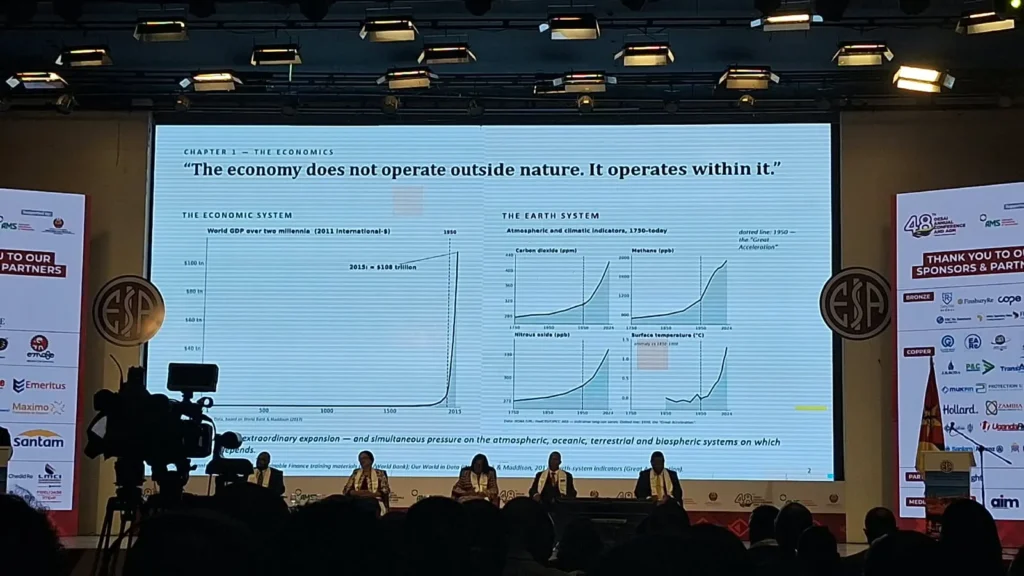
Climate and catastrophe exposure are among the wider risk themes being examined at OESAI 2026.
But identifying a potential catastrophe does not solve the financing problem.
Insurers must still decide how much risk they can retain, how much should be transferred to reinsurers and whether adequate capital exists to meet claims following a major event.
AI therefore becomes a tool within a much larger risk-management system rather than a substitute for capital, underwriting expertise or reinsurance.
A particularly African data challenge
The Pan-African dimension adds another layer. Insurance markets across the continent differ significantly in their size, maturity, data availability, regulation and risk profiles.
A model that performs well in one market cannot simply be assumed to work identically in another. That makes local knowledge particularly important.
Insurers adopting AI will need to combine larger datasets and increasingly sophisticated analytical tools with professionals who understand local industries, customers, weather patterns, regulations and claims behaviour.
The stronger model may therefore be a partnership between technology and human expertise rather than a competition between them.
The human question remains
This may ultimately be the most important takeaway emerging from the Maputo discussion. The debate around AI in insurance is often framed around what jobs machines can replace. For insurers, a more useful question may be what decisions technology can improve.
The answer will differ across underwriting, claims, capital management and customer service. But the test should remain consistent.
Does the technology produce a better outcome? If not, doing the same thing more quickly is unlikely to transform the business.
For Africa’s insurers, the competitive advantage may therefore belong not to the companies using the most AI, but to those using it most intelligently, combining better technology with reliable data and the professional judgement required to understand what the numbers actually mean.

OESAI 2026 is bringing technology into a wider conversation about how African insurers respond to increasingly complex risks.